
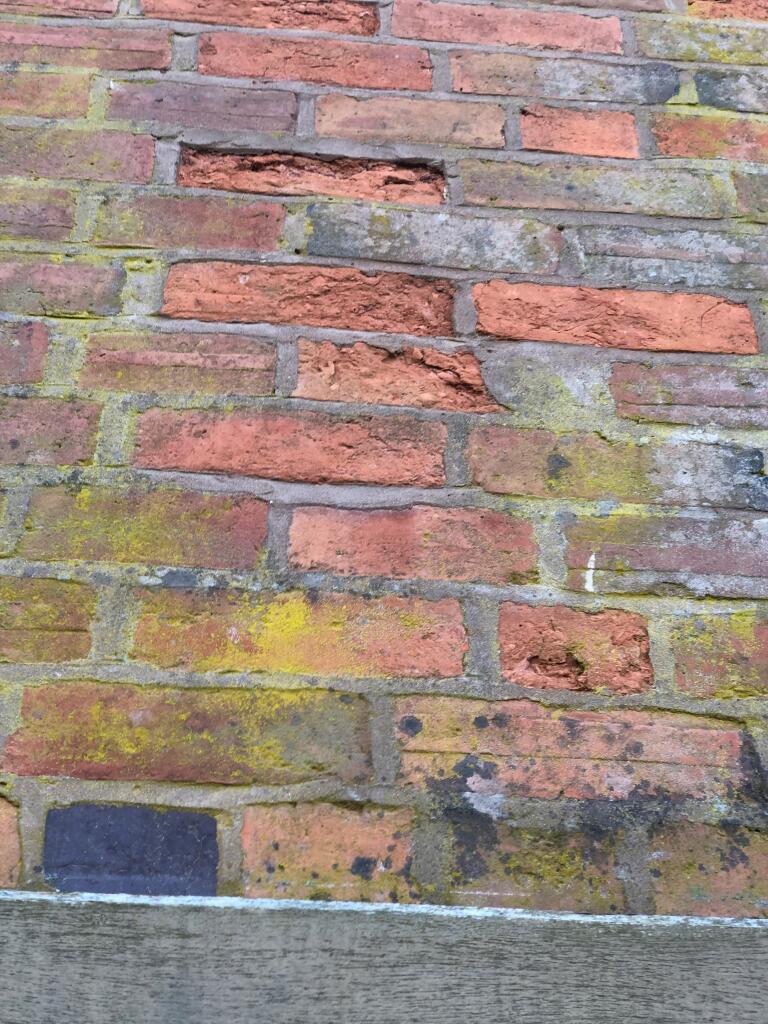
It’s the time of year my customers are calling me regarding frost-blown bricks and masonry, blown mortar, and exploding planters & urns. Good old English Jack Frost doing his bit.
Any architectural salvage dealer with good sense knows which items to protect in winter, but few do. Some stored items of mine have suffered badly this year, so let’s just say I talk a good game. However, the top course of a pallet of bricks blown by frost will cost the dealer a minimum £50, and up to £100 off his margin. Per pallet, on a wrong Winter’s night? Ooh!
If not covered, brick should at least be stacked weathered face down, not on the flat where the brick is most absorbent. Stone should be stacked with the stone as if laid “to bed” i.e. with the wearing face in it’s natural position. Stone faces on their backs will only catch the frost and blow spectacularly.
I was once asked to make an offer on some local Blue Lias flagstones. The seller, a builder, knew their retail value and declined my offer, as usual accusing me of daylight robbery. It was Autumn. When we left it that he should call me, I gave him the good advice to re-stack them from against the wall, and cover for the Winter. They were absolutely mint, of huge sizes, and a workable 3 inches thick. Worth top retail, a small batch of 15 sq metres.
He didn’t call. Come Spring, I had a firm requirement for some quality Lias flags from a discerning customer. I rang the builder. His reply “They’re going to cost me the price of a skip. The whole lot disintegrated and collapsed.” He’d lost the £450 I offered, which included the labour to shift, and now had a £200 disposal problem. I lost potentially the same. More to the point: precious rarities lost to Mother Nature.
Reparations are necessary for materials in situ. Along with my stored materials, I’ve got blown mortar on a run of wall-copings and a couple of flights of steps, laid only last year.
Every year we used to greet Giorgio, the son of a reclamation yard-owner in Italy. Here for three months to improve his English and learn the architectural salvage trade. He was fascinated by frost: Italy is blessed with not only beaches and vast olive-groves, but also the mountains and ski-slopes. But he’d never had to clear the screen with a CD cover! Bear in mind some of the Continent’s limestones are not accustomed, or suited to a British Winter.
An interesting story about frost: For a time, there were very few dealers out there prepared to buy reclaimed parquet flooring. It has to be bone dry, for a start. I had built up a good relationship with a company in Atherstone, operating out of a scruffy unit. They sold a wide range of new hardwood flooring, but found a ready market for reclaimed antique parquet, restored & ready to lay. This required melt-stripping the bitumen off with a flame-gun, and they would plane the faces. All in all, a shitty job.
On one occasion, in freezing January, I had to drop off a sample of some oak parquet flooring due to be lifted from a school hall. When I got there, early evening, all was shut up for the night, so as had become usual, I propped them up against the door-step. At least I would get a price in the morning.
The following day, Patrick called me and yes, we had a deal. But he was excited, and explained that he had retrieved the samples first thing, covered in a heavy frost. To shake the ice off, he had clapped them together… and all the bitumen fell off like black glass.
“I’ve gone through the local ads and bought some second-hand chest freezers,” he enthused. “we’ll give them a trial with this coming lot!”
I have no idea whether the practice continued. Nowadays, they leave the bitumen on, and stick ‘em back down!
Ice is powerful stuff, when expanding!
Come Spring, we can look at remedial works such as repointing. One common mistake in repointing is regularly exposed in Winter when bricks “spall”. This is when the face of the brick blows. Repointing lime or a sandy mortar-mix with 3:1 or 5:1 cement renders the joint waterproof. Rainwater can then only escape via the (softer than the mix) brick or stone. Once frozen, the fissures in the brick swell, and you will see your garden path strewn with brick shrapnel.
The use of clay roofing-tiles on a shallow pitch roof, i.e. less than 35%, will inevitably cause “shaling” of the backs of the tiles, and ultimately disintegration. With such a shallow pitch, rainwater can creep up the backs of the tiles via capillary action. One good freeze can then destroy large areas of roof overnight.
Beware the “perfect storm.” A good soaking, or thaw in sunshine, followed by a fast and hard sub-zero overnight. We can’t wrap our statues & sundials in hessian for months on end, but I am continually surprised to see hundred-year-old items that have survived for a lifetime suddenly lose chunks, leaving an unsightly fresh scar. Usually it is an old knock, such as a wheelbarrow, exposed by the ice. Or it may be the item has been moved to a more exposed spot.
On ornamental stone, moss may look harmless, some may even say attractive, but those green blisters are in fact sponges ready to absorb, freeze, expand and remove the surface of their anchorage. Scrape off with a scraper. Moss on a pantile roof can have the same effect, leaving large areas porous to the elements.
It’s no different than your arthritis throbbing in Winter! Who needs a thermometer? Old sports injuries, and the wear & tear of life’s labours, are all made apparent in the cold. Most roofing tiles will not last forever, and may limp on year after year, but in their old age, nothing will bring their demise closer than a hard cold snap. Likewise, for terracotta of an age, whether it be a flower-pot or chimney-pot, their old injuries will finally succumb when Jack Frost has his day.
“when milk comes frozen in the pail, and Dick the Shepherd blows his nail…”
Busby


0 Comments