
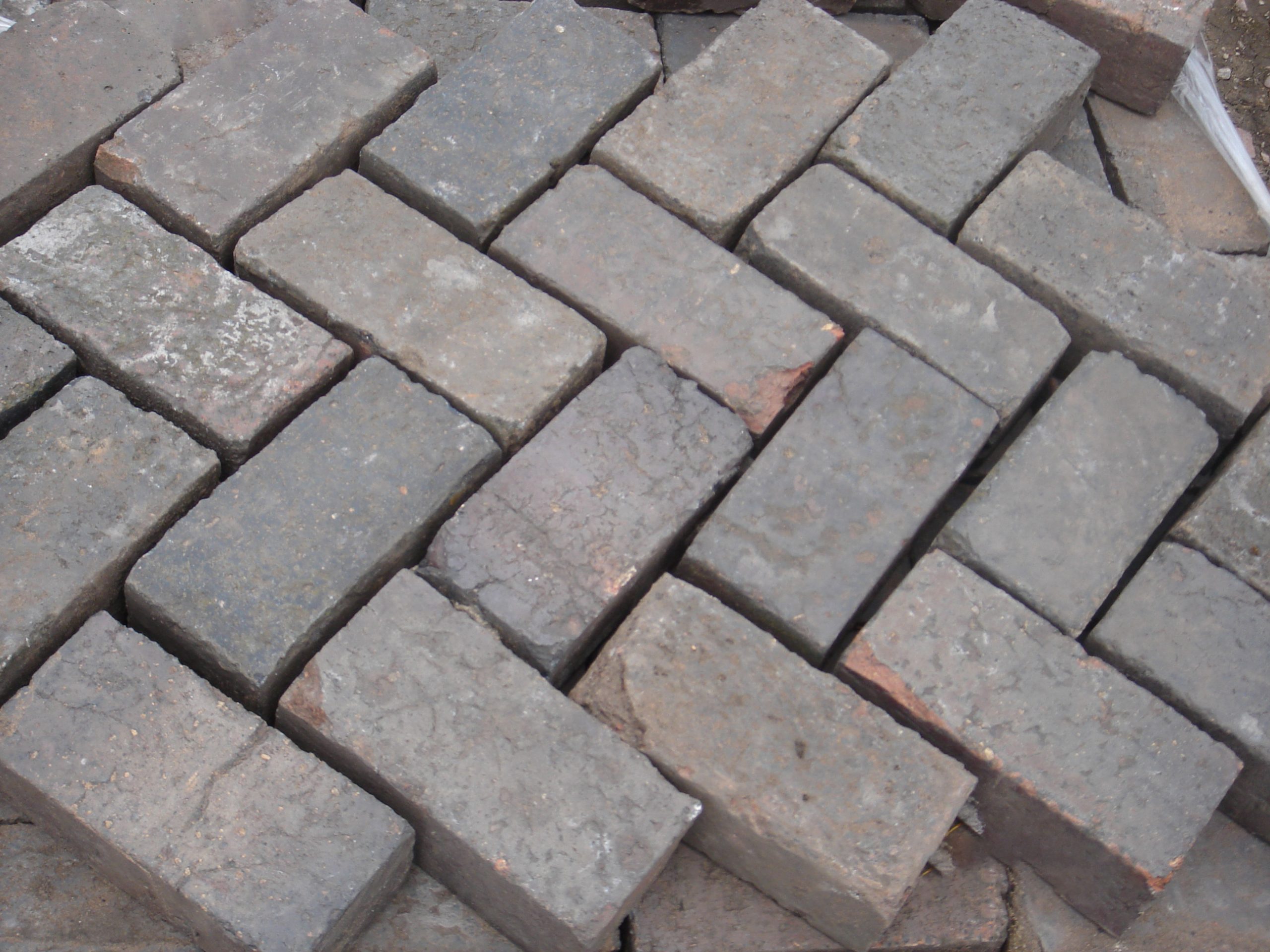
This week I’m looking for blue bricks.
While I’ve always had a passion for bricks of all periods, from ancient roman thins to modern Accringtons, there is something about the durability of Staffordshire blues that warrants my enthusiasm. The fact is, barring trauma, ( i.e. a sledge-hammer), they will last for ever. Frost, and any weather (particularly our English weather) cannot deteriorate them.
I have seen once-square Staffordshire blue bricks worn into flat loaves by cart-wheels & horse-shoes, and still they are fit for purpose.
Though manufactured elsewhere in the country, nothing compares with the Etruria marl from Staffordshire that enables these bricks to be moulded and fired into these indestructible bricks, wall copings, and patterned pavers.
Nothing embodies the might of the Victorians more than Staffordshire blue bricks, the key component of magnificent railway arches, aqueducts, and canal locks & moorings.
I can remember buying lorry-loads in the eighties at 25p each, and selling at 50p. Blues will always hold a premium price. My customer’s bricks this week will cost him £2.00 each, and I still see this as a bargain, given their age and rarity. Some patterned pavers – diamond, stable-block, or maltese cross – may demand as much as £5.00 apiece.
My customer requires 500. Had he required a lorry-load now, I would say no chance. Can’t remember the last time I saw a full load! (bear in mind 1985. Owen Murphy (r.i.p.) lifted and sold over 50,000 blue brick pavers arising from the demolition of Bingley Hall.)
The new blue brick today are just as robust, ring like a bell, and have the same longevity and water-absorption (or lack of!). But they look sickly next to an original indigenous Staffy Blue. Coloured concrete reproduction wall-copings are satisfactory in colour, but lack the sheen produced by firing. Both brick and specials are nevertheless superb products and a good compromise in this 21st Century, enabling traditional patterns and profiles to survive alongside their antique predecessors.
There is, not five miles from me, underneath a mountain of brambles and weeds, a huge pile of great chunks of blue-brick walling, from the entire removal of an 1850’s railway bridge.
The farmer whose farm adjoined the line, allowed them a free tip in the hope of dressing the brick for sale and make a few bob. They were impossible to separate, and thirty years on, have defied all attempts with brick hammer, lump hammer, sledge-hammer, and I suppose some day they will give the crusher a run for it’s money.
If there is mortar present, a blue brick is exceptionally difficult to clean and you will end up with more blisters than brick. Remember that when buying!
My Grandad, an old Brummie, had a saying whenever anyone complained of a cough or cold. He would say “it’s nothing that can’t be sorted by a good rub-down with a blue brick.” I’m unaware of any medicinal properties; I figured that what he was actually saying, was “get on with it.” Which is basically what blue bricks do. Forever.
A couple of years ago, I supplied replacement Staffordshire blue bricks for the floor of the Chapel at the National Trust’s Hidcote Gardens. A 19th century simple pastoral building being renovated for Wedding hire. Most of the bricks lifted easily, bedded as they were in ashes. I supplied the shortfall for those that were lost or missing in the process. Lifting the old floor allowed the luxury of under-floor heating, a rare treat in an old church! The “new” floor looked entirely original and latest reports attest that the thermal retention and heat transfer from these wonderful Victorian originals sees them performing exceptionally well in a new role.
Staffordshire blue bricks are widely travelled because of their unique qualities. Wherever you are, should you be seeking any original Staffordshire blue goods, then, of course, visit your local salvage yard, but I don’t think I’m giving any trade secrets away by stating the obvious, if your mission fails: enquire in Staffordshire!
Salvo.com has a Directory by County for locating Architectural Salvage Yards, but my own personal recommendations go with the following:
Gardiners of Stoke. Friendly & helpful always. https://www.gardinersreclaims.co.uk/
Cawarden Reclaim, Rugeley. Vast stocks, knowledgeable. https://cawardenreclaim.co.uk/
You can send an image and dimensions, and get an immediate appraisal of current stocks. For bricks, make it clear whether they are for paving or facing. For Copings and specials, take a template of the profile. Upstands (the vertical face) can vary tremendously on double weathered (triangles) copings and plinth bricks, as can the angle. Ask if the batch or run are all from the same job.
Remember: they’ll be around for a damn sight longer than you will!
Elsewhere, I will elaborate on Staffordshire blue roofing tiles and fittings; ridge tiles in particular. Similarly indestructible, but this is where the Etruria marl clay gets used to be decorative. And then there are path edgers…
Busby
0 Comments